Lavrentiy Beria
Explore the dark legacy of Lavrentiy Beria, Stalin's ruthless secret police chief, orchestrator of purges, massacres, and a serial rapist.
~11 min readMay 6, 2026 · 06:24 AM
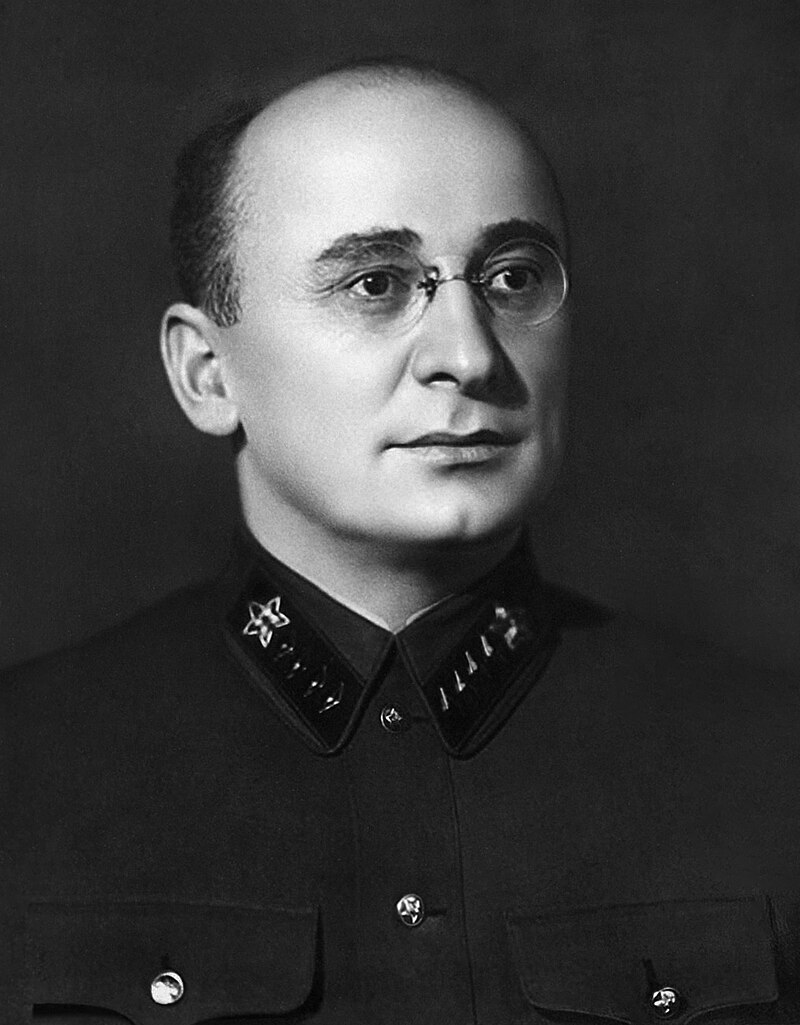
<p>Lavrentiy Pavlovich Beria (29 March [O.S. 17 March] 1899 – 23 December 1953) was a Soviet politician and one of the longest-serving and most influential of Joseph Stalin's secret police chiefs, serving as head of the NKVD from 1938 to 1945 during the country's involvement in the Second World War. He was also a serial rapist and had killed some of his victims. His victims were primarily young women and girls.<br/>An ethnic Georgian, Beria enlisted in the Cheka in 1920, and quickly rose through its ranks. He transferred to Communist Party work in the Caucasus in the 1930s, and in 1938 was appointed head of the NKVD by Stalin. His ascent marked the end of Stalin's Great Purge carried out by Nikolai Yezhov, whom Beria purged. After the Soviet invasion of Poland in 1939, Beria organized the Katyn massacre of 22,000 Polish officers and intelligentsia, and after the occupation of the Baltic states and parts of Romania in 1940, he oversaw the deportations of hundreds of thousands of Poles, Balts, and Romanians to remote areas or Gulag camps. In 1940, Beria began a new purge of the Red Army. After Operation Barbarossa, the Axis invasion of the Soviet Union in June 1941, he was appointed to the State Defense Committee, overseeing security.<br/>Beria expanded the system of forced labour, mobilizing millions of Gulag prisoners into wartime production. He also was in charge of NKVD units responsible for barrier and partisan intelligence and sabotage operations on the Eastern Front. In 1943–44, Beria oversaw the mass deportations of millions of ethnic minorities from the Caucasus, actions which have been described by many scholars as ethnic cleansing or genocide. Beria was also responsible for supervising secret Gulag detention facilities for scientists and engineers, known as sharashkas. From 1945, he oversaw the Soviet atomic bomb project, to which Stalin gave priority; the project's first nuclear device was completed in 1949. After the war, Beria was made a Marshal of the Soviet Union in 1945, and promoted to a full member of the Politburo in 1946.<br/>After Stalin's death in March 1953, Beria became head of the Ministry of Internal Affairs and a First Deputy Chairman of the Council of Ministers. He also formed a triumvirate (a.k.a. troika) alongside Georgy Malenkov and Vyacheslav Molotov which briefly led the country in Stalin's place. However, by June 1953, Beria was removed from power in a coup organized with the support of his colleagues in the Soviet leadership and Marshal Georgy Zhukov. He was arrested, tried for treason and other offenses, and ultimately executed on 23 December 1953.</p>
<p>Early life and rise to power<br/>Lavrentiy Pavlovich Beria was born in Merkheuli, near Sukhumi, in the Sukhum Okrug of the Kutais Governorate (now Gulripshi District, Abkhazia, Georgia, then part of the Russian Empire). He grew up in a Georgian Orthodox family; his mother, Marta Jaqeli (1868–1955), was deeply religious and church-going. Marta was from the Guria region, descended from a noble Georgian family, and was a widow before marrying Beria's father, Pavle Beria (1872–1922), a landowner in Sukhumi Okrug, from the Mingrelian ethnic group.<br/>Beria attended a technical school in Sukhumi, and later claimed to have joined the Bolsheviks in March 1917 while a student in the Baku Polytechnicum (subsequently known as the Azerbaijan State Oil Academy). Beria had earlier worked for the anti-Bolshevik Mussavatists in Baku. After the Red Army captured the city on 28 April 1920, he was saved from execution because there was not enough time to arrange his shooting and replacement; it may also have been that Sergei Kirov intervened. While in prison, Beria formed a connection with Nina Gegechkori (1905–1991), his cellmate's niece, and they eloped on a train.<br/>In 1919, at the age of 20, Beria started his career in state security when the security service of the Azerbaijan Democratic Republic hired him while he was still a student at the Polytechnicum. In 1920, he was enlisted in the Cheka, the original Bolshevik secret police, by Mir Jafar Baghirov. At that time, a Bolshevik revolt took place in the Menshevik-controlled Democratic Republic of Georgia, and the Red Army subsequently invaded. The Cheka became heavily involved in the conflict, which resulted in the defeat of the Mensheviks and the formation of the Georgian SSR. Between 1922 and 1924, Beria was deputy chairman of the Georgian OGPU (as Cheka had been renamed).<br/>He then led the repression of a Georgian nationalist uprising in 1924, after which up to 10,000 people were executed. Between 1924 and 1927, he was head of the secret political department of the Transcaucasian SFSR OGPU. In December 1926, he was appointed Chairman of the Georgian OGPU, and deputy chairman for the Transcaucasian OGPU.</p>
<p>Relations with Stalin</p>
<p>Beria and Joseph Stalin first met in summer 1931, when Stalin took a six-week rest in Tsqaltubo, and Beria took personal charge of his security. Stalin was unimpressed by most of the local party leaders, chosen by the former Georgian party boss, Sergo Ordzhonikidze, but writing to Lazar Kaganovich in August 1932, Stalin commented that "Beria makes a good impression. He is a good organizer, an efficient, capable functionary." According to Stalin's daughter Svetlana:</p>
<p>He was a magnificent specimen of the artful courtier, the embodiment of Oriental perfidy, flattery and hypocrisy who had succeed[ed] in confounding even my father, a man whom it was ordinarily difficult to deceive. A good deal that this monster did is now a blot on my father's name.<br/>In October 1931, when Stalin proposed to appoint Beria Second Secretary of the Georgian Communist Party Central Committee and Second Secretary of the Transcaucasian party, the First Secretary Lavrenty Kartvelishvili exclaimed: "I refuse to work with that charlatan!" Ordzhonikidze also objected to the promotion. Kartvelishvili was replaced by Mamia Orakhelashvili, who wrote to Stalin and Ordzhonikidze in August 1932 asking to be allowed to resign because he could not work with Beria as his deputy. On 9 October 1932, Beria was appointed party leader for the whole Transcaucasian region. He also retained his post as First Secretary of the Georgian CP. In 1933, he promoted his old ally, Baghirov, to the head of the Azerbaijani communist party. He became a member of the Central Committee of the Communist Party of the Soviet Union in February 1934.<br/>During this time, he began to attack fellow members of the Georgian Communist Party, particularly Gaioz Devdariani, who served as Minister of Education of the Georgian SSR. Beria ordered the executions of Devdariani's brothers George and Shalva. In 1935, Beria cemented his place in Stalin's entourage with a lengthy oration titled, "On the History of the Bolshevik Organisations in Transcaucasia" (later published as a book), which emphasised Stalin's role. It quoted from what purported to be police reports from early in the century, which identified Stalin, under his real name Jugashvili, as the leader of the Social Democrats (Marxists) in Georgia and Azerbaijan, though as the historian Bertram Wolfe noted: "These new finds tell a different story and even speak another language from all police documents and Bolshevik reminiscences published [...] while Lenin was alive. The language sounds uncommonly like Beria's own."</p>
<p>The Great Purge</p>
<p>In the first couple of years of mass arrests of members of the Communist Party and Soviet government that began after the assassination of Leningrad party boss Sergei Kirov (1 December 1934), Beria was one of the few regional party leaders considered ruthless enough to purge the region under his control, without outside interference. On 9 July 1936, the First Secretary of the Central Committee of the Armenian Communist Party, Aghasi Khanjian was found dead from a bullet wound. It was officially announced that he had committed suicide, and he was retrospectively denounced as an enemy of the people, but in 1961, the then head of the KGB, Alexander Shelepin reported that he had been murdered by Beria.<br/>On 26 December 1936, Beria summoned the head of the communist party of Abkhazia, Nestor Lakoba, to the Party headquarters in Tbilisi. Beria had Lakoba over for dinner the next day, where he was served fried trout, a favorite of Lakoba's and a glass of poisoned wine. They attended the opera after the dinner, watching the play Mzetchabuki (მზეჭაბუკი; "Sun-boy" in Georgian). During the performance Lakoba showed the first signs of his poisoning and returned to his hotel room, where he died early the next morning. Officially, Lakoba was said to have died of a heart attack, though a previous medical examination in Moscow had shown he had arteriosclerosis (thickening of the arteries), cardiosclerosis (thickening of the heart), and erysipelas (skin inflammation) in the left auricle that had led to his hearing loss. His body was returned to Sukhumi, though notably all the internal organs (which could have helped identify the cause of death) were removed. Lakoba was accused of "nationalist deviationism", of having helped Trotsky, and of trying to kill both Stalin and Beria. With Lakoba dead, Beria effectively took control of Abkhazia and implemented a policy of "Georgification".<br/>In the months that followed Lakoba's death, members of his family were implicated on charges against the state. His two brothers were arrested on 9 April 1937, and his mother Sariya was arrested on 23 August of that year. A trial of thirteen members of Lakoba's family was conducted between 30 October and 3 November 1937 in Sukhumi, with charges including counter-revolutionary activities, subversion and sabotage, espionage, terrorism, and insurgent organization in Abkhazia. Nine of the defendants, including Lakoba's two brothers, were shot on the night of 4 November. Rauf, Lakoba's 15-year-old son, tried to speak to Beria, who visited Sukhumi to view the start of the trial. He was promptly arrested as well. Sariya was taken to Tbilisi and tortured in order to extract a statement implicating Lakoba, but refused, even after Rauf was tortured in front of her. Sariya would die in prison in Tbilisi on 16 May 1939. Rauf was sent to a labour camp, and was eventually shot in a Sukhumi prison on 28 July 1941.<br/>In December 1936, Nikolai Yezhov, the newly appointed commissar of the NKVD, the ministry which oversaw the state security and police forces, reported that more than 300 people had been arrested in Georgia in the previous few weeks. In June 1937, Beria said in a speech, "Let our enemies know that anyone who attempts to raise a hand against the will of our people, against the will of the party of Lenin and Stalin, will be mercilessly crushed and destroyed."<br/>On 20 July, he wrote to Stalin to report that he had 200 people shot, was about to submit a list of another 350 who were also to be shot, and that Shalva Eliava, Lavrenty Kartvelishvili, Maria Orakhelashvili (wife of Mamia Orakhelashvili), and numerous others had all confessed to counter-revolutionary activities but Mamia Orakhelashvili himself was holding out, though he repeatedly fainted under interrogation and had to be revived with camphor. The evidence against all of them was found, after Beria's execution, to have consisted of false confessions extracted under torture. Reputedly, Orakhelashvili's ear drums were perforated and his eyes gouged out.</p>
<p>Head of the NKVD</p>
<p>In August 1938, Stalin brought Beria to Moscow as deputy head of the NKVD. Under Yezhov, the NKVD carried out the Great Purge: the imprisonment or execution of a huge number, possibly over a million, of citizens throughout the Soviet Union as alleged "enemies of the people". By 1938 the oppression had become so extensive that it was damaging the infrastructure, economy, and the armed forces of the Soviet state, prompting Stalin to wind the purge down. In September, Beria was appointed head of the Main Administration of State Security (GUGB) of the NKVD, and in November he succeeded Nikolai Yezhov as NKVD head. Yezhov was executed in 1940.</p>
<p>Beria's appointment marked an easing of the repression begun under Yezhov. Over 100,000 people were released from the labour camps. The government officially admitted that there had been some injustice and "excesses" during the purges, which were blamed entirely on Yezhov. The liberalization was only relative; arrests, torture, and executions continued. On 16 January 1940, Beria sent Stalin a list of 457 "enemies of the people" of whom 346 were marked to be shot. They included Yezhov and his brother and nephews; Mikhail Frinovsky and his wife and teenage son, Yefim Yevdokimov and his wife and teenage son, dozens more former NKVD officers, and the renowned writer Isaac Babel and the journalist Mikhail Koltsov.<br/>Some of the NKVD officers Beria promoted, such as Boris Rodos, Lev Shvartzman, and Bogdan Kobulov were brutal torturers who were executed in the 1950s. The theatre director Vsevolod Meyerhold described being beaten on the spine and soles of his feet until "the pain was so intense that it felt as if boiling water was being poured on these sensitive areas." His interrogation record was signed by Shvartzman. Robert Eikhe, a former high-ranking party official, was sadistically beaten and had an eye gouged out by Rodos, in Beria's office, while Beria watched. He not only permitted and encouraged the beating of prisoners, but in some cases carried it out. One prisoner who survived to give evidence in the 1950s testified that he was brought to Beria's office and accused of plotting to blow up the Moscow metro, which he denied:</p>
<p>Beria hit me in the face. After that, I was given 30 minutes to think in the next room, next to his office, from where the screams and groans of the beaten could be heard. An hour later, called to the office, I was met with the words of Kobulov: "What shall we start beating?"<br/>In March 1939, Beria was appointed as a candidate member of the Communist Party's Politburo. Although he did not rise to full membership until 1946, he was by then one of the senior leaders of the Soviet state. In 1941, he was made a Commissar General of State Security, the highest quasi-military rank within the Soviet police system. In 1940, the pace of the purges accelerated again. During this period, Beria supervised deportations of people identified as "political enemies" from Poland, Lithuania, Latvia and Estonia after Soviet occupation of those countries.<br/>On 5 March 1940, after the Gestapo–NKVD Third Conference was held in Zakopane, Beria sent a note (No. 794/B) to Stalin in which he stated that the Polish prisoners of war kept at camps and prisons in western Belarus and Ukraine were enemies of the Soviet Union, and recommended their execution. Most of them were military officers, but there were also intelligentsia, doctors, priests, and others in a total of 22,000 people. With Stalin's approval, Beria's NKVD executed them in what became known as the Katyn massacre.<br/>From October 1940 to February 1942, the NKVD under Beria carried out a new purge of the Red Army and related industries. In February 1941, Beria became deputy chairman of the Council of People's Commissars, and in June, following Operation Barbarossa, Nazi Germany's invasion of the Soviet Union, he became a member of the State Defense Committee (GKO). During the Second World War, he took on major domestic responsibilities and mobilised the millions of people imprisoned in NKVD Gulag camps into wartime production. He took control of the manufacture of armaments, and (with Georgy Malenkov) aircraft and aircraft engines. This was the beginning of Beria's alliance with Malenkov, which later became of central importance.<br/>In 1944, as the Soviet Union had repelled the German invasion, Beria was placed in charge of the various ethnic minorities accused of anti-sovietism and/or collaboration with the invaders, including the Balkars, Karachays, Chechens, Ingush, Crimean Tatars, Kalmyks, Pontic Greeks, and Volga Germans, collectively known as "The Morgans". All these groups were deported to Soviet Central Asia.<br/>In December 1944, the NKVD supervised the Soviet atomic bomb project ("Task No. 1"), which built and tested a bomb by 29 August 1949. The project was extremely labour-intensive. At least 330,000 people, including 10,000 technicians, were involved. The Gulag system provided tens of thousands of people for work in uranium mines and for the construction and operation of uranium processing plants. They also constructed test facilities, such as those at Semipalatinsk and in the Novaya Zemlya archipelago.<br/>In July 1945, as Soviet police ranks were converted to a military uniform system, Beria's rank was officially converted to that of Marshal of the Soviet Union. Although he had never held a traditional military command, he made a significant contribution to the victory of the Soviet Union in the war through his organisation of wartime production and his use of partisans. Abroad, Beria had met with Kim Il Sung, the future leader of North Korea, several times when the Soviet troops had declared war on Japan and occupied the northern half of Korea from August 1945. Beria recommended that Stalin install a communist leader in the occupied territories.</p>
<p>Post-war politics<br/>With Stalin nearing 70, a concealed struggle for succession amongst his entourage dominated Soviet politics. At the end of the war, Andrei Zhdanov, who had served as the Communist Party leader in Leningrad (now Saint Petersburg) during the war, seemed the most likely candidate. After 1946, Beria formed an alliance with Malenkov to counter Zhdanov's rise. In December 1945, Beria resigned as chief of the NKVD while retaining general control over national security matters as Deputy Prime Minister and Curator of the Organs of State Security under Stalin. However, the new NKVD chief, Sergei Kruglov, was not a supporter of Beria. Also by the summer of 1946 Beria's man, Vsevolod Merkulov, was replaced as head of</p>
<hr/><p><em>Based on Wikipedia article: <a href="https://en.wikipedia.org/wiki/Lavrentiy_Beria" target="_blank" rel="noopener">Lavrentiy Beria</a> – licensed under CC BY-SA.</em></p>