Julius and Ethel Rosenberg
Explore the controversial case of Julius and Ethel Rosenberg, executed as Soviet spies, and uncover declassified evidence that sheds new light on their guilt.
~12 min readMay 6, 2026 · 07:29 AM
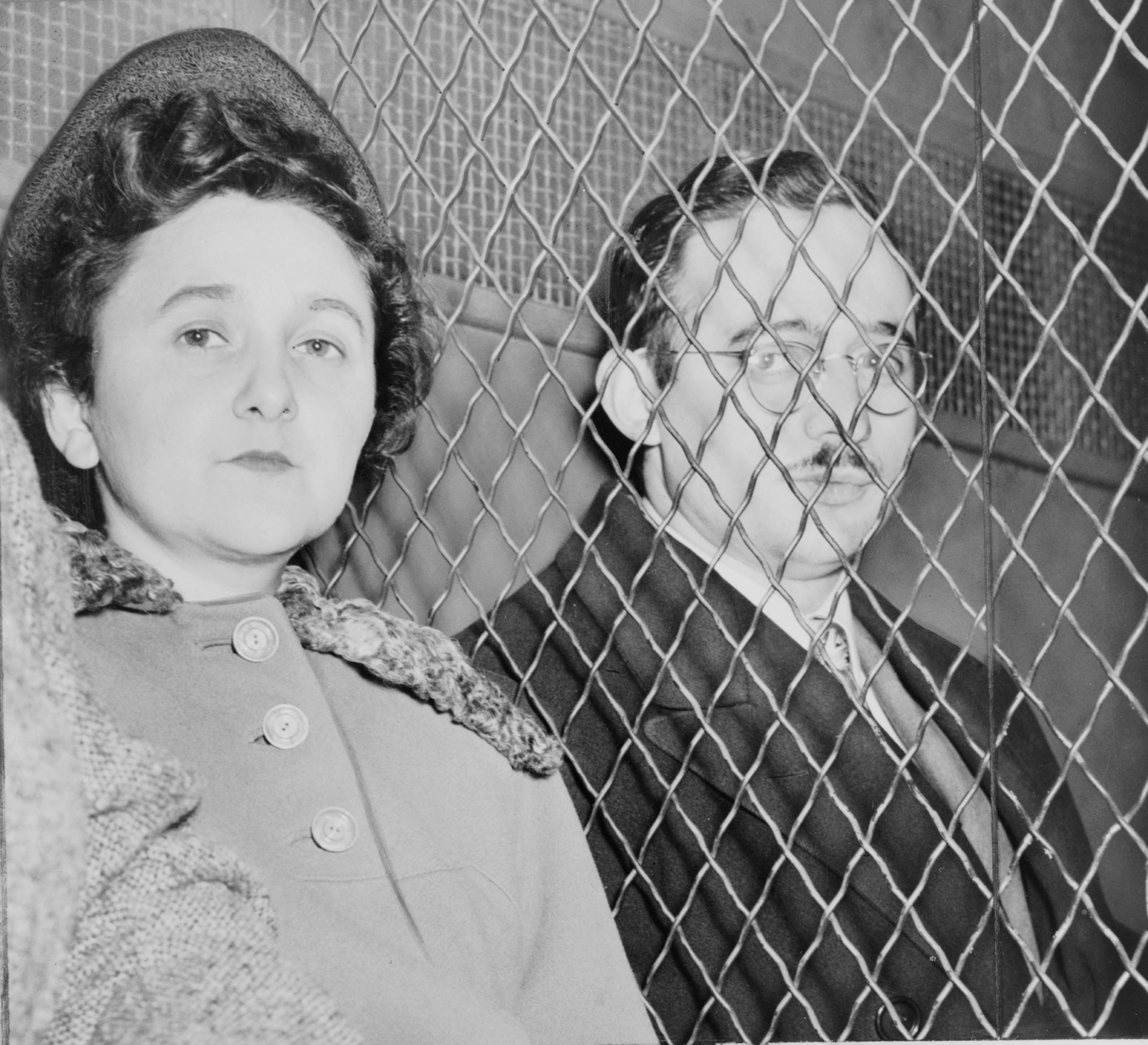
<p>Julius Rosenberg (May 12, 1918 – June 19, 1953) and Ethel Rosenberg (born Greenglass; September 28, 1915 – June 19, 1953) were an American married couple who were convicted of spying for the Soviet Union, including providing top-secret information about American radar, sonar, jet propulsion engines, and nuclear weapon designs. They were executed by the federal government of the United States in 1953 using New York's state execution chamber in Sing Sing in Ossining, New York, becoming the first American civilians to be executed for such charges and the first to be executed during peacetime. <br/>Other convicted co-conspirators were sentenced to prison, including Ethel's brother, David Greenglass (who had made a plea agreement), Harry Gold, and Morton Sobell. Klaus Fuchs, a German scientist working at the Los Alamos Laboratory, was convicted in the United Kingdom. For decades, many people, including the Rosenbergs' sons (Michael and Robert Meeropol), initially maintained that both parents were – and later that Ethel was – innocent of spying and have sought an exoneration from multiple U.S. presidents.<br/>Among records the U.S. government declassified after the fall of the Soviet Union are many related to the Rosenbergs, including a trove of decoded Soviet cables (code-name Venona), which detailed Julius' role as a courier and recruiter for the Soviets. In 2008, the National Archives of the United States published most of the grand jury testimony related to the prosecution of the Rosenbergs. Freedom of Information Act (FOIA) requests filed about the Rosenbergs and the legal case against them have resulted in additional U.S. government records being made public, including formerly classified materials from U.S. intelligence agencies.</p>
<p>Early lives and education</p>
<p>Julius Rosenberg was born on May 12, 1918, in New York City to a family of Jewish immigrants from the Russian Empire. The family moved to the Lower East Side by the time Julius was 11. His parents worked in the shops of the Lower East Side as Julius attended Seward Park High School. Julius became a leader in the Young Communist League USA while at City College of New York during the Great Depression. In 1939, he graduated with a degree in electrical engineering.<br/>Ethel Greenglass was born on September 28, 1915, to a Jewish family in Manhattan. She had a brother, David Greenglass. She originally was an aspiring actress and singer but eventually took a secretarial job at a shipping company. She became involved in labor disputes and joined the Young Communist League, where she met Julius in 1936. They married in 1939.</p>
<p>Espionage<br/>Julius Rosenberg joined the Army Signal Corps Engineering Laboratories at Fort Monmouth, New Jersey, in 1940, where he worked as an engineer-inspector until 1945. He was discharged when the U.S. Army discovered his previous membership in the Communist Party USA. Important research on electronics, communications, radar and guided missile controls was undertaken at Fort Monmouth during World War II.<br/>According to a 2001 book by his former handler Aleksandr Feklisov, Rosenberg was originally recruited to spy for the interior ministry of the Soviet Union, NKVD, on Labor Day 1942 by a former spymaster Semyon Semyonov. Rosenberg had been introduced to Semyonov by Bernard Schuster, a high-ranking member of the Communist Party USA and NKVD liaison for Earl Browder. After Semyonov was recalled to Moscow in 1944 his duties were taken over by Feklisov.<br/>Rosenberg provided thousands of classified reports from Emerson Radio, including a complete proximity fuze. Under Feklisov's supervision, Rosenberg recruited sympathetic individuals into NKVD service, including Joel Barr, Alfred Sarant, William Perl, and Morton Sobell, also an engineer. Perl supplied Feklisov, under Rosenberg's direction, with thousands of documents from the National Advisory Committee for Aeronautics, including a complete set of design and production drawings for Lockheed's P-80 Shooting Star, the first U.S. operational jet fighter. Feklisov learned through Rosenberg that Ethel's brother David was working on the top-secret Manhattan Project at the Los Alamos National Laboratory; he directed Julius to recruit David.<br/>In February 1944, Rosenberg succeeded in recruiting a second source of Manhattan Project information, engineer Russell McNutt, who worked on designs for the plants at Oak Ridge National Laboratory. For this success Rosenberg received a $100 bonus. McNutt's employment provided access to secrets about processes for manufacturing weapons-grade uranium.<br/>The U.S. did not share information with, nor seek assistance from, the Soviet Union regarding the Manhattan Project. The West was shocked by the speed with which the Soviets were able to stage "Joe 1", its first nuclear test, on August 29, 1949. However, Lavrentiy Beria, the head official of the Soviet nuclear project, used foreign intelligence only as a third-party check rather than giving it directly to the design teams, whom he did not clear to know about the espionage efforts, and the development was indigenous. Considering that the pace of the Soviet program was set primarily by the amount of uranium that it could procure, it is difficult for scholars to judge accurately how much time was saved, if any.</p>
<p>Rosenberg case</p>
<p>Arrest</p>
<p>In January 1950, the U.S. discovered that Klaus Fuchs, a German refugee and theoretical physicist working for the British mission in the Manhattan Project, had given key documents to the Soviets throughout the war. Fuchs identified his courier as American Harry Gold, who was arrested on May 23, 1950. <br/>On June 15, 1950, David Greenglass was arrested by the FBI for espionage and soon confessed to having passed secret information on to the USSR through Gold. He also claimed that Julius Rosenberg had convinced David's wife Ruth to recruit him while visiting him in Albuquerque, New Mexico, in 1944. He said Julius had passed secrets and thus linked him to the Soviet contact agent Anatoli Yakovlev. This connection would be necessary as evidence if there was to be a conviction for espionage of the Rosenbergs.<br/>On July 17, 1950, Julius was arrested on suspicion of espionage, based on David Greenglass's confession. On August 11, 1950, Ethel was arrested after testifying before a grand jury. Another conspirator, Morton Sobell, fled with his family to Mexico City after Greenglass was arrested. They took assumed names, and he tried to figure out a way to reach Europe without a passport. Abandoning that effort, he returned to Mexico City. He claimed that he was kidnapped by members of the Mexican secret police and driven to the U.S. border, where he was arrested by U.S. forces. The U.S. government claimed Sobell was arrested by the Mexican police for bank robbery on August 16, 1950, and he was extradited the next day to the United States in Laredo, Texas.</p>
<p>Grand jury</p>
<p>Twenty senior government officials met secretly on February 8, 1950, to discuss the Rosenberg case. Gordon Dean, the chairman of the Atomic Energy Commission, said: "It looks as though Rosenberg is the kingpin of a very large ring, and if there is any way of breaking him by having the shadow of a death penalty over him, we want to do it." Myles Lane, a member of the prosecution team, said that the case against Ethel was "not too strong", but that it was "very important that she be convicted too, and given a stiff sentence." FBI director J. Edgar Hoover wrote that "proceeding against the wife will serve as a lever" to make Julius talk.<br/>Their case against Ethel was resolved 10 days before the start of the trial, when David and Ruth Greenglass were interviewed a second time. They were persuaded to change their original stories. David originally had said that he had passed the atomic data he had collected to Julius on a New York street corner. After being interviewed this second time, he said that he had given this information to Julius in the living room of the Rosenbergs' New York apartment. Ethel, at Julius's request, had taken his notes and "typed them up." In her second interview, Ruth expanded on her husband's version:</p>
<p>Julius then took the info into the bathroom and read it and when he came out he called Ethel and told her she had to type this information immediately ... Ethel then sat down at the typewriter which she placed on a bridge table in the living room and proceeded to type the information that David had given to Julius. As a result of this new testimony, all charges against Ruth were dropped. On August 11, Ethel testified before a grand jury. For all questions, she asserted her right to not answer as provided by the U.S. Constitution's Fifth Amendment against self-incrimination. FBI agents took her into custody as she left the courthouse. Her attorney asked the U.S. commissioner to parole her in his custody over the weekend so that she could make arrangements for her two young children. The request was denied. <br/>Julius and Ethel were put under pressure to incriminate others involved in the spy ring. Neither offered any further information. On August 17, the grand jury returned an indictment alleging 11 overt acts. Both Julius and Ethel Rosenberg were indicted, as were David Greenglass and Yakovlev.</p>
<p>Trial and conviction</p>
<p>The trial of the Rosenbergs and Sobell on federal espionage charges began on March 6, 1951, in the U.S. District Court for the Southern District of New York. Judge Irving Kaufman presided over the trial, with Assistant U.S. Attorney Irving Saypol leading the prosecution and criminal defense lawyer Emmanuel Bloch representing the Rosenbergs. The prosecution's primary witness, David Greenglass, said that he turned over to Julius a sketch of the cross-section of an implosion-type atom bomb. This was the "Fat Man" bomb dropped on Nagasaki, Japan, as opposed to a bomb with the "gun method" triggering device used in the "Little Boy" bomb dropped on Hiroshima.<br/>On March 29, 1951, the Rosenbergs were convicted of espionage. They were sentenced to death on April 5 under Section 2 of the Espionage Act of 1917, which provides that anyone convicted of transmitting or attempting to transmit to a foreign government "information relating to the national defense" may be imprisoned for life or put to death.<br/>Prosecutor Roy Cohn later claimed that his influence led to both Kaufman and Saypol being appointed to the Rosenberg case and that Kaufman imposed the death penalty based on Cohn's personal recommendation. Cohn would go on later to work for Senator Joseph McCarthy, appointed as chief counsel to the investigations subcommittee during McCarthy's tenure as chairman of the Senate Government Operations Committee. In imposing the death penalty, Kaufman observed that he held the Rosenbergs responsible not only for espionage but for American deaths in the Korean War:</p>
<p>I believe your conduct in putting into the hands of the Russians the A-bomb years before our best scientists predicted Russia would perfect the bomb has already caused, in my opinion, the Communist aggression in Korea, with the resultant casualties exceeding 50,000 and who knows but that millions more of innocent people may pay the price of your treason. Indeed, by your betrayal you undoubtedly have altered the course of history to the disadvantage of our country.<br/>The U.S. government offered to spare the lives of both Julius and Ethel if Julius provided the names of other spies and they admitted their guilt. The Rosenbergs made a public statement: "By asking us to repudiate the truth of our innocence, the government admits its own doubts concerning our guilt... we will not be coerced, even under pain of death, to bear false witness."</p>
<p>After conviction</p>
<p>Campaign for clemency<br/>After the publication of an investigative series in the National Guardian and the formation of the National Committee to Secure Justice in the Rosenberg Case, some Americans came to believe both Rosenbergs were innocent or had received too harsh a sentence, particularly Ethel. A campaign was started to try to prevent the couple's execution. Between the trial and the executions, there were widespread protests and claims of antisemitism. At a time when American fears about communism were high, the Rosenbergs did not receive support from mainstream Jewish organizations. The American Civil Liberties Union did not find any civil liberties violations in the case.<br/>Across the world, especially in Western European capitals, there were numerous protests with picketing and demonstrations in favor of the Rosenbergs, along with editorials in otherwise pro-American newspapers. Marxist Jean-Paul Sartre, an existentialist philosopher and writer who won the Nobel Prize for Literature, described the trial as "a legal lynching". Others, including non-communists such as Jean Cocteau and Harold Urey, a Nobel Prize-winning physical chemist, as well as left-leaning figures—some being communist—such as Nelson Algren, Bertolt Brecht, Albert Einstein, Dashiell Hammett, Frida Kahlo, and Diego Rivera, protested the position of the American government in what the French termed the American Dreyfus affair. <br/>Einstein and Urey pleaded with President Harry S. Truman to pardon the Rosenbergs. In May 1951, Pablo Picasso wrote for the communist French newspaper L'Humanité: "The hours count. The minutes count. Do not let this crime against humanity take place." The all-black labor union International Longshoremen's Association Local 968 stopped working for a day in protest. Cinema artists such as Fritz Lang registered their protest. President Dwight D. Eisenhower, supported by public opinion and the media at home, ignored the overseas demands. Pope Pius XII appealed to Eisenhower to spare the couple, but Eisenhower refused on February 11, 1953. All other appeals were also unsuccessful.<br/>Defense of the Rosenbergs surged in November and December 1952 and was organized by the Communist Party of the Soviet Union—confirmation of which occurred with the publication of KGB documents obtained by Alexander Vassiliev in 2011. Proponents of clemency argued that the Rosenbergs were actually "innocent Jewish peace activists". According to American historian Ronald Radosh, the Soviet Union's goal was "to deflect the world's attention from the sordid execution of the innocent [Jewish Slánský trial defendants] in Soviet-controlled Czechoslovakia.</p>
<p>Execution<br/>The execution was delayed from the scheduled date of June 18 because Supreme Court Associate Justice William O. Douglas had granted a stay of execution on the previous day. This stay resulted from intervention in the case by Fyke Farmer, a Tennessee lawyer whose efforts had been scorned by Bloch. The execution was scheduled for 11 p.m. the evening of June 19, during the Sabbath, which begins and ends around sunset. <br/>Bloch asked for more time, filing a complaint that execution on the Sabbath offended the defendants' Jewish heritage. Rhoda Laks, another attorney on the Rosenbergs' defense team, also made this argument before Judge Kaufman. The defense's strategy backfired. Kaufman, who stated his concerns about executing the Rosenbergs on the Sabbath, rescheduled the execution for 8 p.m.—before sunset and the Sabbath—the regular time for executions at Sing Sing where they were being held.<br/>On June 19, 1953, Julius died from the first electric shock. Ethel's execution did not go smoothly. After she was given the normal course of three electric shocks, attendants removed the strapping and other equipment only to have doctors determine that her heart was still beating. Two more electric shocks were applied, and at the conclusion eyewitnesses reported that smoke rose from her head. The Rosenbergs were the only American civilians executed for espionage during the Cold War. The funeral services were held in Brooklyn on June 21. The Rosenbergs are buried at Wellwood Cemetery, a Jewish cemetery in Pinelawn, New York. The Times reported that 500 people attended and some 10,000 stood outside:</p>
<p>The bodies had been brought from Sing Sing prison by the national "Rosenberg committee" which undertook the funeral arrangements, and an all-night vigil was held in one of the largest mortuary chapels in Brooklyn. Many hundreds of people filed past the biers. Most of them clearly regarded the Rosenbergs as martyred heroes and more than 500 mourners attended to-day's services, while a crowd estimated at 10,000 stood outside in burning heat. Mr. Bloch [their counsel], who delivered one of the main orations, bitterly exclaimed that America was "living under the heel of a military dictator garbed in civilian attire": the Rosenbergs were "Sweet. Tender. And Intelligent" and the course they took was one of "courage and heroism."<br/>In 1953, socialist historian W. E. B. Du Bois wrote a poem titled "The Rosenbergs", which began "Crucify us, Vengeance of God, as we crucify two more Jews" and ended "Who has been crowned on yonder stair? Red Resurrection? Or Black Despair?"</p>
<p>Soviet nuclear program</p>
<p>Senator Daniel Patrick Moynihan, vice-chairman of the Senate Select Committee on Intelligence, investigated how much the Soviet spy ring helped the USSR to build its bomb. Moynihan found that in 1945 physicist Hans Bethe estimated that the Soviets would build its bomb within five years. Moynihan wrote in his book Secrecy: "Thanks to information provided by their agents, they did it in four."<br/>Nikita Khrushchev, leader of the Soviet Union from 1953 to 1964, wrote in his posthumously published memoir that he "cannot specifically say what kind of help the Rosenbergs provided us" but that he learned from Joseph Stalin and Vyacheslav Molotov that they "had provided very significant help in accelerating the production of our atomic bomb." Boris V. Brokhovich, the engineer who later became director of Chelyabinsk-40, the plutonium production reactor and extraction facility that the Soviet Union used to create its first bomb material, alleged that Khrushchev was a "silly fool". He said the Soviets had</p>
<hr/><p><em>Based on Wikipedia article: <a href="https://en.wikipedia.org/wiki/Julius_and_Ethel_Rosenberg" target="_blank" rel="noopener">Julius and Ethel Rosenberg</a> – licensed under CC BY-SA.</em></p>