GRU (Russian Federation)
Explore the GRU, Russia's secretive and expansive military intelligence agency, known for high-stakes operations and a vast global network.
~11 min readMay 6, 2026 · 07:35 AM
Listen to article
Speed1.0x
<p>The Main Directorate of the General Staff of the Armed Forces of the Russian Federation, formerly the Main Intelligence Directorate, and commonly known by its previous abbreviation GRU, is the foreign military intelligence agency of the General Staff of the Armed Forces of the Russian Federation tasked with advancing military intelligence through collecting and analyzing intelligence from around the world and conducting clandestine and covert operations. The GRU controls the military intelligence service and maintains its own special forces units. <br/>Unlike Russia's other security and intelligence agencies – such as the Foreign Intelligence Service (SVR), the Federal Security Service (FSB), and the Federal Protective Service (FSO) – whose heads report directly to the president of Russia (see Intelligence agencies of Russia), the director of the GRU is subordinate to the Russian military command, reporting to the Minister of Defence and the Chief of the General Staff.<br/>The directorate is reputedly Russia's largest foreign intelligence agency, and is distinguished among its counterparts for its willingness to execute riskier "complicated, high stakes operations". According to unverified statements by Stanislav Lunev, a defector from the GRU, in 1997 the agency deployed six times as many agents in foreign countries as the SVR, and commanded some 25,000 Spetsnaz troops.</p>
<p>History</p>
<p>Origins and early history</p>
<p>The first Russian body for military intelligence dates from 1810, in the context of the Napoleonic Wars raging across Europe, when War Minister Michael Andreas Barclay de Tolly proposed to Emperor Alexander I of Russia the formation of the Expedition for Secret Affairs under the War Ministry (Russian: Экспедиция секретных дел при военном министерстве); two years later, it was renamed the Special Bureau (Russian: Особая канцелярия).<br/>In 1815, the Bureau became the First Department under the General Chief of Staff. In 1836, the intelligence functions were transferred to the Second Department under the General Chief of Staff. After many name-changes through the years, in April 1906, the Military intelligence was carried out by the Fifth Department under the General Chief of Staff of the War Ministry.</p>
<p>The GRU's first predecessor in Soviet Russia was established by the secret order signed on 5 November 1918 by Jukums Vācietis, the first commander-in-chief of the Red Army (RKKA), and by Ephraim Sklyansky, deputy to Leon Trotsky, the civilian leader of the Red Army. (Since 2006, the Russian Federation has officially observed the date of 5 November as the professional holiday of military intelligence in Russia.) The military human intelligence service thus established was originally known as the Registration Agency (Registrupravlenie, or Registrupr; Russian: Региструпр) of the Field Headquarters of the Revolutionary Military Council of the Republic; Semyon Aralov was its first head. Its early history was marked by a series of reorganisations influenced by the Soviet-Polish War, the consolidation and restablisation of the Soviet Union, and the general reorganisation of the Red Army; this included changes to its name, status, and responsibilities.Throughout most of the interwar period, the men and women who worked for Red Army Intelligence called it either the Fourth Department, the Intelligence Service, the Razvedupr, or the RU. […] As a result of the re-organisation [in 1926], carried out in part to break up Trotsky's hold on the army, the Fourth Department seems to have been placed directly under the control of the State Defense Council (Gosudarstvennaia komissiia oborony, or GKO), the successor of the RVSR. Thereafter its analysis and reports went directly to the GKO and the Politburo, apparently even bypassing the Red Army Staff.<br/>The first head of the Fourth Directorate was Yan Karlovich Berzin, who remained in the post from March 1924 until April 1935 (in 1938, he was arrested and executed as a Trotskyite during the Stalinist purges). Military intelligence was known for its fierce independence from the rival "internal intelligence organizations", such as the NKVD, and later KGB; however, public statements of Soviet military intelligence veterans state the Fourth Directorate, and later GRU, had always been operationally subordinate to the KGB. Military intelligence was headquartered in a small and nondescript complex west of the Kremlin, whereas the NKVD was in the very centre of Moscow, next to the building that housed People's Commissariat for Foreign Affairs at the bottom of Kuznetsky Most. Consequently, Soviet military intelligence came to be known in Soviet diplomats' cant as distant neighbours (Russian: дальние соседи) as opposed to the near neighbours of the NKVD/KGB.</p>
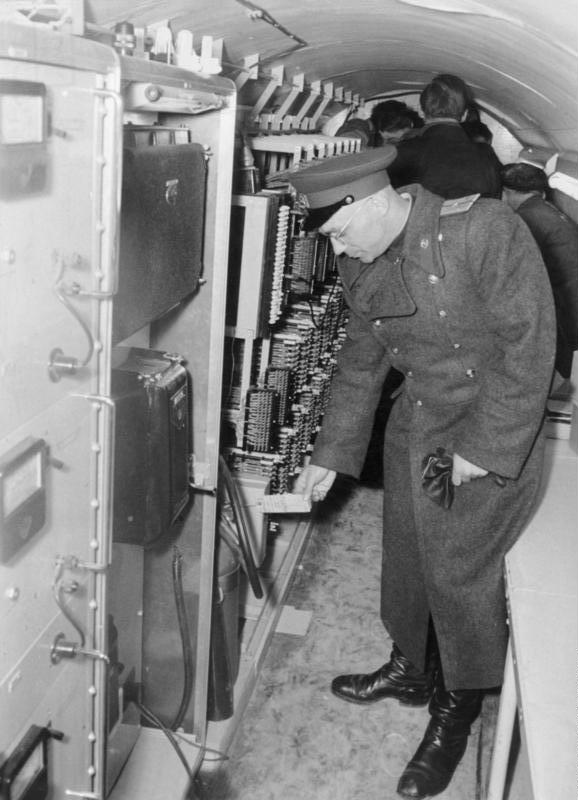
<p>Cold War<br/>The GRU was created under its current name and form by Joseph Stalin in February 1942, less than a year after the invasion of the Soviet Union by Nazi Germany. From April 1943 the GRU handled human intelligence exclusively outside the USSR. In addition to operations against the Axis powers, GRU is credited with having infiltrated the British nuclear weapon programme and up to 70 American government and scientific institutions.<br/>During the Cold War, the GRU, like many of its Western rivals, maintained rezidenturas, or resident spies, worldwide; these included both "legal" agents, based at Soviet embassies with official diplomatic cover, and "illegal" officers without cover. It also maintained a signals intelligence (SIGINT) station in Lourdes, Cuba and other Soviet-bloc countries. Though less well known than the KGB, with which it shared a fierce rivalry, GRU is known to have been involved in several high-profile episodes; this included opening backchannel negotiations with the U.S. government during the Cuban Missile Crisis and contributing to the Profumo scandal that partly contributed to the fall of a British administration. GRU was distinguished for its "closer ties with revolutionary movements and terrorist groups, greater experience with weapons and explosives, and even tougher training for recruits"; new recruits were allegedly shown footage of a traitorous officer being fed into a crematorium alive.<br/>The existence of the GRU was not publicized during the Soviet era, though it was mentioned in the 1931 memoirs of the first OGPU defector, Georges Agabekov, and described in detail in the 1939 autobiography, I Was Stalin's Agent, by Walter Krivitsky, the most senior Red Army intelligence officer ever to defect. GRU became widely known in Russia, and outside narrow confines of the Western intelligence community, during perestroika, due partly to the writings of "Viktor Suvorov" (Vladimir Rezun), a GRU officer who defected to Great Britain in 1978 and wrote about his experiences in the Soviet military and intelligence services. According to Suvorov, even the General Secretary of the Communist Party of the Soviet Union, the country's de facto leader, needed to undergo a security screening to enter GRU headquarters.</p>
<p>Post-Soviet period<br/>Following the dissolution of the USSR in December 1991, the GRU continued as an important part of Russia's intelligence services, especially since it was the only one to more or less maintain operational and institutional continuity: the KGB had been dissolved after aiding a failed coup in 1991 against the then Soviet President Mikhail Gorbachev. It is now succeeded by the Foreign Intelligence Service (SVR) and the Federal Security Service (FSB).<br/>Evidencing its growing strategic profile, in 2006 the GRU moved to a new headquarters complex at Khoroshovskoye Shosse, which cost 9.5 billion rubles to build and incorporates 70,000 square meters. In April 2009, President Dmitry Medvedev fired then-GRU head Valentin Korabelnikov, who had headed the GRU since 1997, reportedly over Korabelnikov's objections to proposed reforms. Pursuant to these reforms, the following year, the official name of the unit was changed from "GRU" to the "Main Directorate of the Russian General Staff", or "G.U."; however, "GRU" continues to be commonly used in media. The GRU underwent severe reductions in funding and personnel following the 2008 Russo-Georgian War, during which it failed to discover the more advanced anti-aircraft weapons obtained by Georgia. However, it continued to play a key role in several Russian operations, including in Russia's intervention in eastern Ukraine in 2014 and the subsequent annexation of Crimea. GRU agents were also implicated in numerous cyberwarfare operations across the West, including in the U.S., France, and Germany. Many of its successes took place during the tenure of Igor Sergun, who headed the service from late 2011 until his death in early January 2016. Sergun's sudden death shortly after the restoration of the GRU's influence led to speculations of foul play by Russian adversaries.<br/>The tenure of Sergun's successor, Igor Korobov, was marked by what some news media construed as multiple high-profile setbacks, such as the thwarted 2016 coup d'état attempt in Montenegro, the failed 2018 Salisbury poisoning, and an unprecedented number of disclosed GRU agents. Korobov died on 21 November 2018, "after a serious and prolonged illness", according to the official Defence Ministry statement. His death provoked speculations and unverified reports of him having fallen ill in October that year following a harsh dressing-down from President Vladimir Putin. However, former CIA station-chief Daniel Hoffman cautioned in 2017 that some of the Russian intelligence's recent operations that appeared to be botched might have been intended for discovery. Similarly, in 2019, Eerik-Niiles Kross, a former Estonian intelligence official, opined that GRU's apparent sloppiness "has become part of the psychological warfare. It's not that they have become that much more aggressive. They want to be felt. It's part of the game."<br/>On 2 November 2018, while marking the GU's 100th anniversary, President Putin proposed restoring the agency's former name: Главное разведывательное управление (GRU).</p>
<p>Organizational structure<br/>Since 1977, the director of the Intelligence Directorate of the Main Staff of the Russian Navy has also typically been the deputy director of the GRU. The Navy Intelligence Directorate was made subordinate to the fifth directorate of the GRU.</p>
<p>1997 organization<br/>The GRU is organized into numerous directorates, directions, and sections. According to the data available in open sources in 1997, the structure of the Main Directorate consists of at least 12 known directorates and several other auxiliary departments.</p>
<p>The First Directorate is responsible for intelligence in Europe.<br/>The Second Directorate is geographically responsible for the Western Hemisphere.<br/>The Third Directorate is geographically responsible for Asia.<br/>The Fourth Directorate is geographically responsible for Africa and the Middle East.<br/>The Fifth Directorate is responsible for military operations intelligence, including naval and air force intelligence.<br/>The Sixth Directorate is responsible for signals intelligence (SIGINT) and space intelligence. It uses over 20 different types of aircraft, a fleet of 60 SIGINT collection vessels, satellites, and ground stations to collect signals intelligence. Together with FAPSI, the GRU operates SIGINT collection facilities in over 60 diplomatically protected facilities throughout the world. These agencies also operate ground collection facilities within former Soviet states' territory.<br/>The Seventh Directorate is responsible specifically for NATO.<br/>The Eighth Directorate deals with special purpose administration.<br/>The Ninth Directorate is responsible for military technology.<br/>The Tenth Directorate is the department of war economics.<br/>The Eleventh Directorate is the department of strategic doctrines and arms.<br/>The Twelfth Directorate is responsible for information warfare.</p>
<p>2020 organization<br/>The American Congressional Research Service, based on interviews with various experts, gives the following organization of the GRU, although it acknowledges that the organization's true structure is "a closely guarded secret."<br/>4 Regional Directorates:</p>
<p>First Directorate: European Union<br/>Second Directorate: North and South America, the United Kingdom, Australia, and New Zealand<br/>Third Directorate: Asia<br/>Fourth Directorate: Africa<br/>11 Mission-Specific Directorates:</p>
<p>Fifth Directorate: Operational Intelligence<br/>Sixth Directorate: Electronic/Signals intelligence<br/>GRU cyber capabilities, Unit 26165 (allegedly the hacking group Fancy Bear/APT28/STRONTIUM), and Unit 74455 (allegedly the Sandworm Team)<br/>Seventh Directorate: NATO<br/>Eighth Directorate: Russian Spetsnaz (special forces)<br/>Ninth Directorate: Military technology<br/>Tenth Directorate: Military economy<br/>Eleventh Directorate: Strategic doctrine<br/>Twelfth Directorate: Information Operations (separate from American information operations)<br/>Space Intelligence Directorate<br/>Operational and Technical Directorate<br/>External Relations Department</p>
<p>Units</p>
<p>Unit 26165</p>
<p>Unit 26165, also known as Fancy Bear, STRONTIUM, and APT28, is a cyber operations/hacking group. Unit 26165 was originally created during the Cold War as the 85th Main Special Service Center, responsible for military intelligence cryptography. The Netherlands has accused Unit 26165 of also being involved in the attempted 2018 OPCW hack and targeting its investigation into the 2014 downing of Malaysia Airlines Flight 17 (MH17), for which the Dutch investigation blames pro-Russian Ukrainian separatists armed with surface-to-air missiles by Russia.</p>
<p>Unit 29155</p>
<p>Unit 29155 is tasked with foreign assassinations and other covert activities aimed at destabilizing European countries. The Unit is thought to have operated in secret since at least 2008, though its existence only became publicly known in 2019. It is commanded by Maj. Gen. Andrei Vladimirovich Averyanov and based at the headquarters of the 161st Special Purpose Specialist Training Center in eastern Moscow. Its membership included decorated veterans from the Soviet war in Afghanistan and Russia's most recent series of wars in Chechnya and Ukraine. It has been linked to the 2014 Russian annexation of Crimea, the 2015 poisonings of Bulgarian arms dealer Emilian Gebrev (also spelled Emilyan), the 2016 Montenegro coup attempt, and the poisoning of Russian defector Sergei Skripal. Unit 29155 operatives have also been tracked to Switzerland during the time (early 2018) other GRU units hacked the World Anti-Doping Agency (then investigating state-sponsored doping by Russian Olympians) and attempted to hack the Organisation for the Prohibition of Chemical Weapons (then investigating the Douma chemical attack by Russia-backed Bashar al-Assad and evidence in the Skripal case). Spain has also investigated the travel of Unit 29155 member Denis Sergeev (who has also used the name Sergei Fedotov) to Barcelona in 2017 around the time of the 2017 Catalan independence referendum. The unit is also accused of being behind the alleged Russian bounty program where Taliban militants were paid to kill American troops, although the program's existence is uncertain, unproven, and unverified.<br/>The FBI, CISA, and NSA concluded that cyber actors linked to the GRU's 161st Specialist Training Center (Unit 29155) had conducted cyber operations targeting global entities for espionage, sabotage, and reputational harm since at least 2020. Starting on 13 January 2022, these actors deployed the WhisperGate malware against several Ukrainian organizations. The advisory detailed the tactics and techniques used by Unit 29155 and offered further analysis of WhisperGate.</p>
<p>Unit 35555<br/>Unit 35555 is a socio-psychological research laboratory linked to supporting Wagner and other private military companies.</p>
<p>Unit 54777</p>
<p>Unit 54777, alternately called the 72nd Special Service Center, is one of the GRU's primary psychological warfare capabilities. Unit 54777 retains several front organizations, including InfoRos and the Institute of the Russian Diaspora. The unit originated from Soviet GLAVPUR (Glavnoye Politicheskoye Upravlenie, or the Main Political Department) and was created in early 1990s and notably employed colonel Aleksandr Viktorovich Golyev, whose memoirs were published in 2020 along with other GRU documents. In the 1990s, the unit focused on pro-Soviet disinformation in newly split republics such as Lithuania and Chechnya. In later years the unit covered a broad range of activities from running NGOs targeting Russian expatriates in Western countries (InfoRos, Institute of the Russian Diaspora, World Coordinating Council of Russian Compatriots Living Abroad, Foundation for Supporting and Protecting the Rights of Compatriots Living Abroad) and manipulating public opinion in Russia and abroad in preparation for armed conflicts such as in Georgia, Donbas or Syria.</p>
<p>Unit 74455</p>
<p>Unit 74455, also known as the Sandworm Team or the Main Center for Technologies, used various fictitious online identities (DCLeaks and Guccifer 2.0) to coordinate the release of the politically sensitive stolen documents with WikiLeaks for "maximum political impact" starting on the eve of the 2016 Democratic National Convention. Its guilt has been reported by American media and a Senate Intelligence Committee investigation. In October 2020, the United States Department of Justice indicted six Unit 74455 GRU officers for multiple cyberattacks, including the December 2015 Ukraine power grid cyberattack, the 2017 Macron e-mail leaks, the 2017 NotPetya attacks, the 2018 Winter Olympics hack (for which the GRU attempted to frame North Korea), several 2018 attacks on Skripal case investigators, and a 2018–2019 cyberattack campaign against Georgian media and the Georgian Parliament.</p>
<p>SATCOM<br/>Since the mid-1970s the GRU has maintained a satellite communications interception post near Andreyevka, located approximately 80 kilometres (50 miles) from Spassk-Dalny, Primorsky Krai.</p>
<p>GRU illegals<br/>According t</p>
<hr/><p><em>Based on Wikipedia article: <a href="https://en.wikipedia.org/wiki/GRU_(Russian_Federation)" target="_blank" rel="noopener">GRU (Russian Federation)</a> – licensed under CC BY-SA.</em></p>